Get Paid To Promote, Get Paid To Popup, Get Paid Display Banner
Showing posts with label Miniseries. Show all posts

Review: North and South

Monday, May 9, 2011

I heard about North and South from various places: Amazon recommendations, other blogs, even some of my followers recommended it. A while ago, my mom and I were at Barnes and Noble, and we picked up North and South along with Downton Abbey. We finally got to watch North and South last week. Here's what I thought.
Box Art

Synopsis
When Mr. Hale, a clergyman, has a matter of conscience on his mind regarding his position, he uproots his family from Helston in the south of England to Milton, an industrial town in the north of England, to become a tutor. Mr. Hale's daughter, Margaret, takes an immediate dislike to Milton: she witnesses an employer of a cotton mill mistreating one of his employees. Margaret soon finds out that her father has taken a new pupil, Mr. Thornton, the same employer that witnessed mistreating his employee.

Characters
There are a couple of members of the cast that you might recognize: Mrs. Hale was played by Lesley Manville who was Mrs. Rose in Cranford; Nicholas Higgins was played by Brendan Coyle who was Robert Timmins in Lark Rise to Candleford and John Bates in Downton Abbey. Frederick Hale was played by Rupert Evans who was Frank Churchill in the latest adaptation of Emma.
Margaret Hale (Right) and Mr. Thornton (Middle) in Milton:
notice the grey overtones.

For about 75% of the miniseries, I really disliked Mr. Thornton... and even by the end, I only got to the point where I admitted that he was "okay". It seemed like he couldn't control his temper most of the time, or he would be extremely rude. By the end, when he started to get along with Nicholas Higgins, a former union leader, and how he started to take interested in the newly orphaned children that Nicholas was taking care of, he started to get a little more humanity to him and became a little more likable. To me, it was a bit difficult to like his character throughout the entire miniseries.

It took me a little bit to like Margaret, but it didn't take too long. For a while, I thought that she took any opportunity of butting her way into conversations between Mr. Thornton and her father, which kind of caused me to think that she was looking for any chance to argue with Mr. Thornton. By the second half of the miniseries, she stopped that and even started to like Mr. Thornton. Overall, I like her character, but like any character in literature, she has her faults like the rest of us.

Scenery
Helstone in the South
I didn't like the scenery very much throughout 95% of the movie. Most of the scenes took place in Milton: since it is an industrial town, there are a lot of gray colors (due to smoke). Milton was not pretty to look at, which was probably the angle that the film-makers were going for. The country scenes were very pretty! Whenever scenes were in the country, the colors were very bold and popped out at you. The scenes in the country were few though, so there are only a couple of scenes where you get to see the vibrant colors.

Costumes
I thought the costuming was good. I liked some of Margaret's outfits. My favorite one has to be the white blouse with the dark green skirt. Some of her dresses I really didn't care for (like the dress she had during the final scene at the train station: I really didn't like that one), but for the most part, I liked her dresses. Some of Fanny Thornton's dresses were also nice (but I disliked her character).

Music
The music was mostly very serious since the story was a serious story. Most of the pieces were slow moving and had a lower tone to them.

Overall: 4/5
I liked North and South, but I wouldn't say it's my favorite. Spoiler Towards the end, it seemed like characters were dying off one by one. At least four prominent characters died by the end and one was about to die in a short while. End of Spoiler I tend to like more lighthearted stories, so it can be difficult for me to like a more serious storyline, but I did like it. It kept me interested throughout the entire miniseries. There are some implications, violence and people do die in this miniseries, but other than that there really isn't anything too bad in this miniseries.

North and South is available on a two disk DVD. It is 235 minutes long and has four episodes.

Review: Sense and Sensibility (2008)

Monday, March 28, 2011

I had gotten a couple of requests on here about this version of Sense and Sensibility. I was a little skeptical about this version, since I am so fond of the Emma Thompson version. I know with the Emma Thompson version, they did leave out a lot of scenes and characters (which I found out as I was reading the book), but I still liked it a lot despite all that was missing. Then I watched this version, and I still liked it, but I did notice some similarities and differences. Here are my thoughts on this version. Note: I do tend to make comparisons to the 1995 movie in this review, so be warned. :-)

Box Art
Synopsis - Taken from the review for Sense and Sensibility (1995)
Sense and Sensibility follows the story of two sisters: sensible Elinor Dashwood (Hattie Morahan) and passionate Marianne Dashwood (Charity Wakefield). When their father Mr. Henry Dashwood dies, his property, Norland, is passed to his son from his first marriage, John Dashwood. Before he died, Henry Dashwood made John promise to take care of his current wife and three daughters (Elinor, Marianne, and Margaret). John promises to take care of them and wants to give them some money, but he is persuaded by his wife, Fanny, not to. Meanwhile, the Dashwood women prepare to receive John and Fanny, and when they arrive, Fanny announces that her brother Edward Ferrars (Dan Stevens) will be joining them. Edward arrives and him and Elinor form an attachment, which is broken off by Fanny.


Characters
There are a few actors and actresses that you might recognize. Linda Bassett, who was Mrs. Jennings, was on Lark Rise to Candleford, Dan Stevens (Edward Ferrars) is on Downton Abbey, and Hattie Morahan was on one episode of Lark Rise to Candleford.

A lot of the characters that were left out of the 1995 movie were included in this miniseries. We get to see Lady Middleton (she was dead in the 1995 movie), the Middleton children (there were no children in the movie), Harry Dashwood (John and Fanny's son who wasn't in the movie at all), Anne Steele (who wasn't in the movie), and Mrs. Ferrars (who was only mentioned in the movie). There were also scenes that were included in this version that were left out of the 1995 movie: Willoughby's confession scene, the dinner with Mrs. Ferrars, among others.

Anne and Lucy Steele talking with Elinor.
The addition of Anne Steele, Mrs. Ferrars, and the Middletons were very good editions. I have always wondered with the 1995 movie what it would be like if those characters were added in. Anne Steele was very amusing: Spoiler the scene where she tells Fanny about Lucy's engagement to Edward was hilarious! End of Spoiler I thought, however, that there should have been more scenes with Lady Middleton and Mrs. Palmer, but definitely with Mrs. Palmer. She wasn't in the miniseries as often as she should have been. I was happy that they included the dinner with Mrs. Ferrars; the 1995 movie left out that Edward was supposed to marry Miss Morton, but I'm glad that they included that with the dinner scene.

Margaret Dashwood's character, I could nearly swear, was taken from the 1995 movie. In the movie, she was hiding under a table in the library and was prone to be a little shy. Here, they have her hiding under the bed, hiding up trees, and (in a similar scene) she was crouched down behind a table in the library at Norland and from the screen view almost looks like she was hiding. Also, like in the movie, they show the friendship between her and Edward, something that was not in the book. I am glad that they made Margaret thirteen instead of a few years younger like in the movie.
Left to Right: Colonel Brandon, Edward Ferrars,
John Willoughby, Marianne Dashwood, and Elinor Dashwood.

Elinor and Marianne were portrayed well. I thought that Marianne should have been a little more emotional (just enough to prove Jane Austen's point on how over-emotion can be a bad thing). But overall, I thought these were good portrayals of Elinor and Marianne.

I thought that the actor who was Willoughby was too creepy for his role. I know he isn't a good character, but the Dashwood women were supposed to notice how handsome, charming, and unthreatening he was. Here, it seemed that anyone would be creeped out by him and you couldn't trust him just by looking at him. *shudders*

Scenery/Scenes
The scenery was a little dark for an Austen adaptation. I know Sense and Sensibility isn't as lighthearted as Pride and Prejudice or Emma, but I didn't think that it was very dark, just serious. The colors were also a little washed-out and dull for my taste; it seemed like many days were cloudy for the Dashwoods. The scenery would have been much better if there was more color present.

There were a couple of invented scenes. Like the 1995 movie, invented was the scene in which Marianne goes out for a walk in the rain at Cleveland, gets sick, and needs Colonel Brandon to bring her back. There were also scenes added to develop Edward's friendship with Margaret.

I also want to include a small note: I did not watch the first scene of this miniseries. A while ago, I saw what it was and turned it off. It was a bit of a mature scene (which I thought was out of place since Jane Austen didn't go into detail about that part). But when I heard that it was the only mature scene throughout the whole miniseries, I gave it a second chance. I can assure you that throughout the rest of the miniseries there weren't any more mature scenes.
Elinor, Marianne, and Mrs. Jennings at the ball in London.

Costuming
I did like the costuming, although I found the dresses to have a rather low waistline for the Regency era. The costuming seemed to go back and forth between Regency era gown to Gregorian gowns, which for some characters I found a little confusing, namely for Mrs. Ferrars. Mrs. Ferrars is rich and in London, in the middle of the English fashion world: why, then, was she wearing out-of-date fashions for a dinner party? I would imagine her character buying the latest fashions, not using old gowns. I noticed that Mrs. Jennings occasionally would wear older gowns, but she also had Regency gowns.

Elinor and Marianne both dressed nicely. I liked Elinor's dark purple over robe that she wears on the cover; it has a similar build to the over robes in the 1995 movie. Marianne tended to dress in bright, colorful gowns while Elinor's tended to be more sedate (showing their contrasting personalities).

Music
The music was okay, but it was mostly serious. Most of the songs had a sad overtone and were a little slow moving. There was one piece of music, however, that I thought didn't fit in with the time period. In the scene where Colonel Brandon goes out to look for Marianne at Cleveland, there was kind of an odd beginning to the piece, almost as if it came out of an 80's action movie. It seemed a little out of place, but it was a small issue.

Overall: 4/5
I'm still partial to the 1995 movie (in fact, I probably like that one a little bit more). For the 1995 version, even though characters and scenes were left out, I thought that the overall gist of Sense and Sensibility was capture (overtones, character personalities, etc.). Here, it stays closer to the book as far as scenes and including characters goes, but I thought it was a little darker than what Sense and Sensibility was written to be. But I did enjoy watching this miniseries. I wouldn't be sorry to watch it again!

Sense and Sensibility is available on DVD either on it's own or can be purchased in a collection along with Persuasion (2007). It runs for 180 minutes and it is divided into three episodes.

Review: Middlemarch

Monday, March 7, 2011

Lastly in The George Eliot Collection, my mom and I watched Middlemarch (I will have reviewed all the movies in The George Eliot Collection except for one, Silas Marner). I never heard about it until I started watching period dramas.

Box art
Synopsis
There are two main storylines to Middlemarch. The first one is about a woman, Dorothea Brooke (Juliet Aubrey), who marries the middle-aged Casaubon. She wishes to help him with his research, but he gets irriated when she tries to help him. She meets Casaubon's young cousin, Will Ladislaw, and the two quickly become close. The second is about a doctor named Tertius Lydgate, who comes to Middlemarch. He soon afterwards, marries the beautiful Rosamond Vincy and then deals with financial problems.

Characters
Fans of Colin Firth (Pride and Prejudice) might be interested to know that his brother, Jonathan Firth, was in this movie. Other than that, there weren't any actors or actresses that I recognized.

I had a really hard time telling the characters apart for a good majority of the movie. Most of the men looked too much alike. This made it difficult to follow certain parts of the story. They should have dressed them differently from each other or give the characters different hair colors, something to tell them apart. It's wasier to tell woman characters apart, since they all wear their hair differently and dress differently. With the men, it was difficult, indeed!

Casaubon, Dorothea, and Landislaw.
Since the plot is divided into two storylines, it would be inevitable to compare them with each other. The whole storyline with Dorothea was a bit uninteresting: Spoilers she marries an older man hoping to help him on his research, but he doesn't want her to help him, she starts to love his cousin (who looked shifty, if you ask me), and then her husband dies and his will prevents her from marrying his cousin. End of Spoilers There really wasn't anything very interesting going on in that plot. It was all a bit dull.

The Lydgate story fared a little bit better than the Dorothea story. It was a little bit more interesting, but even throughout most of that story, it was one bad thing happening after another. If you're looking for something to cheer you up, this isn't the right storyline for you...

Scenery
Kind of disappointing. Usually for BBC miniseries, there is such lovely scenery and bright, beautiful colors. I don't know if they used an inferior camera or the technology wasn't great, but the colors did not look that good. There was also a brief screen or two towards the end where the picture was very poor, but after a few shots, it went back to normal. Scenes took place in Middlemarch and a couple in Rome, both inside and outside.

Costuming
Rosamond and Lydgate on their wedding day.
Nothing really spactacular as far as costuming was in this miniseries. Since Dorothea has a plain personality, she was dressed in very plain clothing. I will say that Rosamond had very pretty dresses; her dresses had a very nice color on them and they were in very pretty styles. Her dresses were probably the best throughout the entire miniseries.

Like I said before, they should have varied the men's costumes, since it was difficult to tell them apart.

Overall: 1/5
Not very good. The whole miniseries was dull, uninteresting, and hard to follow. I didn't like it very much. There was one adult scene, but it didn't last too long. It was hard to pay attention what was going on throughout the miniseries. I probably wouldn't watch it again. I know there are a lot of people who love this miniseries, but I did not like it. Although, Rosamond's costumes were very nice: if you are looking for costume ideas, you might want to take a look at her dresses.

Middlemarch is available on DVD through The George Eliot Collection or you can purchase it on it's own. It runs for 375 minutes. It has six episodes with varying lengths.

Review: The Buccaneers

Monday, February 21, 2011

My mom and I went to Borders one evening. We searched among the DVDs for some bargains, but couldn't find any until I saw a wall with a bunch of bargains. We looked at them and saw The Buccaneers, which we both heard about, but didn't know anything about, but for $15, we decided to try it.

Synopsis
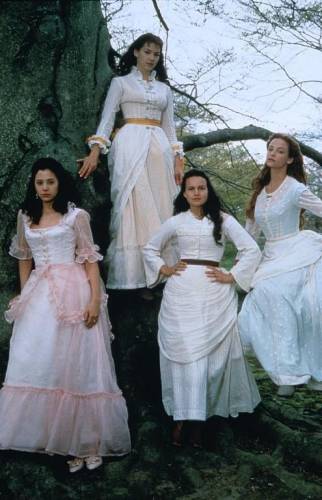
Four "new money" American girls, Virginia St. George, Nan St. George (Carla Gugino), Conchita Closson, and Lizzy Elmsworth, cannot get into upper New York society until Nan's governess, Laura Testvalley, suggests that they try a season in England. The girls go over to England and find themselves husbands, however marriage to rich Englishmen is not what they expected. Nan makes the best marriage materially, but she becomes very unhappy and finds that she loves Guy Thwait (Greg Wise).

Characters
I really only recognized two of the cast. I recognized Carla Gugino (Nan) from Night at the Museum and Greg Wise (Guy Thwait) from both Sense and Sensibility and Cranford. The rest of the cast seemed to be new to me (although I thought the actor that played Lord Richard, who marries Conchita early in the miniseries, was Alan Rickman, but he just looked a lot like him).

The Buccaneers: Conchita, Lizzy,
Nan, and Virginia
For the first part of the movie, the girls act... well, like little girls. It seemed that all they do is run around outside and tumble down hills. If they wanted to show them having fun, they should have done so that was more becoming of adults, not three year olds. I suppose if they wanted to show them running around outside maybe once in a while, but it seemed like for the first half of the miniseries that was all they did. It was kind of hard to take them seriously.

It seemed like at the end, either no one got what they wanted, no one was happy, or someone was happy, but got this happiness through scandalous behavior. None of these characters were good role models, which, for me at least, makes it extremely difficult to relate to any of the characters and hence I have a hard time liking the movie. Even Miss Testvalley, who I liked at first because she seemed like she had a good head on her shoulders, started to make bad judgments and became less likable towards the end.
Scenery
As usual, BBC does a great job with picking great scenery. The story shifts between America and England. Both places have great houses, more so in England where all the aristocrats live. There is a brief outdoor scene by a house near the sea. The houses are very big and nicely furnished. The only problem I had was in one house, there was a room full of immodest paintings. I understand that a lot of paintings had that style, and it would be one thing if they were in the room and not focused on for too long, but there were multiple scenes where the pictures are viewed (and zoomed in upon and examined). I didn't particularly care for that at all. Excepting that one part, there is very lovely scenery in this miniseries.

Nan and Miss Testvalley
Costumes
Hit and miss. Sometimes, they did look nice, but there were other times that they did not look that great. This story takes place during the bustle era of the Victorian era (early 1870's). Some of the clothes that they picked for Nan did not flatter her at all; other times, she looked alright, but there were just some of those times where she was not flattered by her clothes. Whatever they were doing before when she looked alright, they should have done that throughout the miniseries.

Overall: 0.5/5
I will come out and say this bluntly: this movie is definately not for children. There are many adult topics discussed and there were some very mature scenes. From what I read, these added scenes were not in the original novel, which leads me to this question: "Why did they add them in the first place?" Those additional scenes, from what I have read, were why this film was controversial; I can see why. While some costumes were alright and the scenery did afford some nice color (hence why it didn't get a flat 0), they were not enough to save this film. The characters become increasingly dislikable as the series went on. I wouldn't really recommend this film.

The Buccaneers is available on DVD. It runs for 212 minutes.

Pictures from here.

Review: Mill on the Floss

Monday, January 24, 2011

Haven't watch movies from The George Eliot Collection in a while. My mom and I had some time this weekend to watch Mill on the Floss, which neither of us had heard of before we got The George Eliot Collection. We were able to watch it in one evening, even though it was a miniseries.
Box Art

Synopsis
Mill on the Floss follows the story of Maggie and Tom Tulliver, two siblings who live at a mill by a river. When their father, Mr. Tulliver, loses the mill to Mr. Wakem, a lawyer, he suffers a stoke. Mr. Tulliver stays at the mill as Mr. Waken's manager until his death, though he despises working for Mr. Waken. Meanwhile, Maggie grows fond of Phillip Waken, Mr. Wakem's hunchbacked son.

Characters
Watchers of Keeping Up Appearances will notice that Judy Cornwell, who was Daisy in Keeping Up Appearances, is much seen as Mrs. Tulliver, Maggie and Tom's mother. Other than her, I didn't see anyone else that I would have recognized. But, on to the characters...

What was up with young Maggie? The girl was positively nuts! Between randomly cutting her hair and abusing her doll, this girl was crazy. She also would change moods very quickly: she would go from being glad to see her cousin, Lucy, and asking her to stay with them for a while to pushing her into the mud. Thankfully, she does grow out of this very wild behavior; if she was going to be like that the whole miniseries, it would have been less enjoyable.

Adult Maggy reading outside.

Adult Maggie really mellowed out. She seemed much more likable than she was when she was younger - she was less... crazed. She still would have her tiffs with Tom, but they didn't seem to last as long as the one when they were younger. What bothered me a little was that her and Tom seemed to fight a lot, but then it seemed like they were best friends only a short while later. There was no period after the fights where they wouldn't talk to each other a while. I'm not saying that they shouldn't talk to each other, but it's natural to not talk to someone you were fighting with for a while.

Tom always seemed to want to starts fights all the time. I would understand this if he was always a boy, but even when he grows up, he always seems to start fights with Maggie. It got a little annoying after a while.

Scenery
Some of the outdoor scenes were nice, but since this was made in the late 70's, the miniseries comes across as more like a play (which seems to be common for BBC adaptations prior to the 90's probably due to the lack of technology that we have today in filming). Obviously, the colors aren't going to be as striking as some of the more recent period dramas. There were a couple of nice outdoor scenes, though. Scenes took place outside along the river or in the forest or indoors in country houses, barns, or a warehouse. There was one scene in a conservatory in a fancy house, which was nice to see.

Costumes
Lucy and Tom seated while Maggie looks under the sheets
in the background.

Some of the costumes were nice. The dresses looked like they were from the 1830's or 1840's. Some did include the big sleeves popular during the 1830's period, so those dresses I did not particularly like, but some of the others I did.

Adult Maggie had a couple of nice dresses. One dress in particular was a blue dress that she wore when Phillip Wakem was drawing her portrait. I thought the color was a nice blue.

Young Lucy looked so sweet. She seemed to wear a lot of white dresses, and her hair was always very nicely arranged. It was a shame that young Maggie pushed her into the mud and ruined her lovely dress!

Maggie's aunts' dresses I did not like very much. They had the big sleeves of the 1830's period, which I never really cared for. I suppose because they had money, they could afford the latest fashions, but 1830's fashions never really impressed me too much.

Music
Not much music to speak of. The only significant song was the theme song. It can be a little piercing if you have the volume up on your TV too much. Other than that, there wasn't much music.

Overall: 3.5/5
Overall, I didn't hate it, but it's not my favorite. Spoiler This could have something to do with the fact that this story has a sad ending, and I always preferred happy endings to sad endings. Spoiler It was okay to watch once, but I don't know if I would watch it again, not because I disliked it, but rather because I have already seen it.

Mill on the Floss is available on DVD either as a part of The George Eliot Collection or can be bought on it's own. It is made up of eight half-hour episodes and runs for about 212 minutes.

Review: Wives and Daughters

Monday, January 17, 2011

I've heard about Wives and Daughters, but I didn't know anything about it other than it was written by Elizabeth Gaskell, who wrote Cranford. My mom bought the DVD and we watched it over a couple of weekends.
Box Art

Synopsis
Seventeen year old Molly Gibson's (Justine Waddell) life gets turned upside down when her father (Bill Paterson) remarries the selfish Hyacinth Clare Kirkpatrick (Francesca Annis), a widow. When Hyacinth's daughter, Cynthia (Keeley Hawes), comes to live with them, Molly forms a quick friendship with her; however, Cynthia harbors a secret that could ruin her reputation.

Characters
You will recognize a couple of actors and actresses in Wives and Daughters. Justine Waddell is, I believe, in a verision of Great Expectations (though I have never seen it). You will also find Michael Gambon (Emma and Cranford), Francesca Annis (Cranford), Barbara Flynn (The Barchester Chronicles, He Knew He Was Right, Cranford), Barbara Leigh-Hunt (Pride and Prejudice) among others.

Update 8/1/11: Maria Elisabeth from Miss Georgiana Darcy also noted that Rosamund Pike from Pride and Prejudice (2005) was also in here as Lady Harriet. Thanks Maria Elisabeth!

Molly (Justine Waddell) and
Cynthia (Keeley Hawes)
I absolutely found Hyacinth's character very irritating! She is oblivious, selfish, condescending, and incredibly silly. She was just very irritating to watch. Spoiler When Squire Hamley came to ask if Molly could visit the very ill Mrs. Hamley, Hyacinth says that she can't go because Molly has to accompany her somewhere! How absolutely selfish and uncaring! End of Spoiler I had to feel sorry that Molly has to deal with her condescension. I suppose her irritating character was intended, but still I had to feel embaressment for Molly.

It was interesting to see Molly's and Cynthia's friendship form, since they both have different personalities. Cynthia, since she is much more worldly than Molly, can be a little more outspoken, while Molly is a little more quiet (but she does voice her opinions when needed). I actually liked Molly better than Cynthia; there was something in Cynthia's attitude that I didn't like (whether she sounded too fake or something else). Molly seemed more genuine to me.


Scenery
Molly and her father (Bill Paterson) overlooking
the scenery.
You get some very nice scenery in Wives and Daughters. Most of the scenes take place in the English country side, but some scenes feature Africa. The colors are very nice and bold, and the houses are very pretty and nicely furnished. Overall, Wives and Daughters is very pretty to look at.

Costumes
The costumes were a hit and miss with me. Some of them I really liked, but others I hated. I'm not really a fan of big-sleeved fashions of the 1830's, which could have something to do with the fact that I didn't like some of the fashions.


Molly reading a book; I love this jumper/undershirt combo!
Probably it was Molly's wardrobe that I liked the best, though I didn't like all of her dresses. I particularly liked the blue jumper dress and under-shirt that she had on; it was so cute! I also liked the white dress that she wears at Hamley Hall; it almost reminded me of some of the Regency Era dresses that I've seen in other miniseries. Some of her other dresses, however, I disliked. There was the plaid dinner dress that she wore at Hamley Hall: wrong fabric or wrong pattern, but either way plaid did not work for that dress.


Molly and Lady Harriet (Rosamund Pike) going to Mr. Gibson and
Mrs. Kirkpatrick's wedding. Featuring one of Lady Harriet's hairstyles
throughout the miniseries.

I liked some of Lady Harriet's dresses. The dress that she wore for being an amateur bridesmaid was very pretty. I also thought that the outfit that she wore for riding was a good color. Throughout most of the miniseries, I liked the way that she arranged her hair. However, towards the end she had a very short haircut which I did not like at all. I thought that it was a little out of place for the period; it seemed too modern to me.


I did not like Hyacinth or Cynthia's wardrobe. Their dresses had the big sleeves that were fashionable at the time, so that could be why I don't particularly like their dresses since I don't care for dresses from that time period. I will say that Hyacinth's wardrobe fit her perfectly; it was outlandish.

I will say that the trims, fabric prints, and embroidery on all of the dresses were very lovely!


Music
The music shifts back and forth between very flowing, beautiful pieces to more serious pieces. The more serious pieces are usually played when Cynthia is involved in something. A couple of the dance numbers were very bouncy and fun, but others were more flowing and smooth. There are some nice music pieces in here.

Overall:  4/5
Overall, I enjoyed this miniseries. I didn't particularly care for some of the dresses, but there are a couple that caught my attention and that I liked. The acting was well done (though Hyacinth made me cringe). A good miniseries, in my opinion.

Wives and Daughters is available on DVD. It is divided into four episodes, each one hour long.

Review: Pride and Prejudice (Restored Edition)

Monday, December 27, 2010

For Christmas, I got Pride and Prejudice: Restored Edition, which is pretty much what you would get if you bought Pride and Prejudice on Blu-Ray but on DVD. Here, I'll be reviewing the quality of the DVD, not the miniseries itself. For the story itself, click here.

Box Art
Picture Quality
The colors are fantastic! Where in the original the colors appear to be washed out, here they are much more vibrant. You get to see more colors that you otherwise would not have seen. This greatly improves the wide views of the scenery and makes it even more wonderful. I have pictures below because, especially in this instance, a picture can speak a thousand words.

Audio
You will notice upon first viewing that the sound is a little bit different from the original release of Pride and Prejudice. The soundtrack sounds lower than the original, and even some of the speaking parts might sound a little lower, though the speaking parts are less noticable. I have read elsewhere that people have found Mrs. Bennet's voice very high and shrill, so they like that her voice isn't as piercing as it was. I didn't mind Mrs. Bennet's voice in the original release: if I did think it was high, I would have thought that it would be in her character to sound shrill (and maybe even a bit hystarical). Some of the singing parts have a noticable lower pitch compared to the original. It is a bit different from the original.

Comparison
Personally, between the original DVD release and the restored edition, I prefered the picture quality of the restored edition, but the audio of the original. I probably prefer the audio from the original because I personally never found anything wrong with it in the first place, though now I know some people thought Mrs. Bennet's voice was a little high. I do love the improved picture quality; it does the scenery a great justice.

Overall
I would recommend this DVD. Though I am still partial to the original audio, the new audio isn't bad at all; people new to Pride and Prejudice would most likely not find the audio a problem. The picture quality is very stunning and a great improvement. You get about the same quality of picture as the Blu-Ray version but for the price of a DVD. It's really great if you want Blu-Ray quality, but don't have a Blu-Ray player nearby.

Pride and Prejudice: Restored Edition is available online and in the stores. Below are the screenshots comparing the original to the Restored Edition.


Original
 
Remastered
Original

Remastered


Original

Remastered


Review: Daniel Deronda

Sunday, December 5, 2010

Hey everyone. Here is this week's review, however I might take a little break from reviews for a week or two: I have a couple of last papers due and finals are coming up. Hopefully once Christmas break starts, things will calm down and I'll start up on the reviews again. I'll try to post in the upcoming couple of weeks, but it depends on how busy I am. In the meanwhile, enjoy the review!

I have seen the preview for Daniel Deronda in a couple of DVDs. It was the third my mom and I watched in The George Eliot Collection. We were interested in seeing it because Romola Garai (who was Emma Woodhouse in Emma) was in it. Here are some of my thoughts.
Box Art

Synopsis
At a casino in Germany, Gwendolyn Harleth (Romola Garai), as she is gambling away her money, notices a man. This man, she finds out, is Daniel Deronda (Hugh Dancy), the supposed illegitimate son of the rich Sir Hugo Mallinger.

The story flashes back to when Gwendolen's family moved to a new neighborhood. She meets Mr. Grandcourt (Hugh Bonneville), who proposes marriage to her shortly after meeting her. Gwendolen accepts, but upon finding out that he has a mistress and children with her, she leaves for Germany and goes to the casino where she meets Daniel Deronda.

Daniel Deronda, meanwhile, doesn't know what to do with his life yet. One day, as he was boating, he saves a Jewish girl from drowning; her name is Mirah Lapidoth (Johdi May). Mirah has recently come back to England after being taken away by her father to look for her mother and brother. Daniel is determined to help her.
Characters
Daniel Deronda (Hugh Dancy), Gwendolen (Romola Garai),
and Mr. Grandcourt (Hugh Bonneville).
There are some actors that can be recognized that are in Daniel Deronda: Romola Garai (Emma) as Gwendolen, Hugh Dancy (Ella Enchanted) as Daniel Deronda, Amanda Root (Persuasion) as Mrs. Davilow, David Bamber (Pride and Prejudice (1995)) as Lush, even Anna Popplewell (Chronicles of Narnia) as a brief speaking role as Fanny Davilow.
The characters are a mixed bag. On the one hand, you have likable characters like Daniel and Mirah, but on the other hand, characters like Gwendolen are irritating and characters like Mr. Grandcourt are to be hated.

Gwendolen is pretty irritating throughout the whole miniseries: she acts arrogant, and Spoiler marries Mr. Grandcourt because he is rich and because she doesn't want to be a governess. End of Spoiler  I'm sorry, but she pretty much walked into all of her troubles. It was pretty much her fault: she tried to control a situation and she never had control at all

It was interesting to see the Jewish society in Daniel Deronda. You usually don't see that perspective in other period dramas. With characters like Mordecai and Mirah, you get a perspective of the Jewish people in 1870's England.

Gwendolen and Mr. Grandcourt talking
at an archery contest.

Scenery
There are some very nice country scenes, and some of the Italy scenes look quite nice too. Some of the overtones to certain scenes were a little darker and drearier than others due to certain aspects of the story being more serious than others. Scenes ranged from country houses and the surrounding areas, manor houses, the Jewish neighborhood in London, and a sea resort town in Italy.

Costuming
There are some very nice costumes in Daniel Deronda. What is interesting is that the book, from what I've read (as I have never read the book), is supposed to take place in the 1860's; during the 1860's, the crinoline (or hoop skirt) was the fashionable thing to wear. However, in this miniseries, the story takes place in the 1870's when the bustle was the fashionable thing to wear. So, the costumes here utilized the bustle rather than the crinoline.

Gwendolen dressed very nicely, but considering that her family had some money, she could afford it. Her archery dress is very striking: the creamy white and red colors seemed to work very well. However, I didn't really like the dark purple one that she wears later in the miniseries; the color did not complement her skin. Excepting the purple dress, her other outfits were pretty and elegant.

Mirah's dresses were not as striking as Gwendolen's, but considering she is not as rich as Gwendolen, it is understandable. Her dresses were plainer and had darker colors. They were made out of much simpler material than Gwendolen's dresses.

Mirah Lapidoth (Johdi May), the singer.


Music

There is quite a bit of singing, considering Mirah is a singer; she sings opera music in foreign languages, and they sounded nice. Gwendolen also sings, and as a part of the story she later wants to become a singer, but she was told that she was too old to start singing; because of that, she couldn't become a singer. Her voice wasn't bad at all, but compared to Mirah's voice, it was small in comparison.
Overall: 3/5
While not the worst period drama that I've seen, Daniel Deronda isn't the best. There are some positives such as the likeable characters (Daniel, Mirah, etc.) that keep you hoping throughout the story that everything will turn out well for them, lovely scenery to look at, and some of the singing is nice. However, there are some negatives. Gwendolen's character is quite irritating, and though you feel sorry for her at times, you still feel that she had some hand in her suffering. There are some adult scenes and implications, so this is probably not the best thing to show to children. There is a little violence, and a couple of people die (though not through the violence).

Daniel Deronda is available on DVD either in The George Eliot Collection, or just on it's own. It runs for 210 minutes. There are three episodes on one disk.

Review: Cranford

Friday, November 26, 2010

Sorry everyone that the review for this week was late in coming. I was really busy with school this week (I know, right before Thanksgiving...). The next review will hopefully be posted on December 6th. Here is the review!

Cranford... It was something that I have seen on the Masterpiece Theater website or advertised on PBS, but didn't know what it was. I had never heard of it or the author, Elizabeth Gaskell. My mother bought the DVD collection (which included both Cranford and Return to Cranford). Once I watched it, I was glad that I did.
Box Art

Synopsis
Cranford combines three of Elizabeth Gaskell's books into one miniseries: Cranford, Mr. Harrison's Confessions, and My Lady Ludlow. Young Mary Smith returns to the small town of Cranford, her mother's home, and stays with two sisters: Deborah Jenkyns (Eileen Atkins) and Matilda "Matty" Jenkyns (Judi Dench). At the same time, a new doctor arrives in Cranford; Doctor Harrison, a man who has a good reputation, arrives to help the aging Doctor Morgan, and meanwhile gains the attentions of the ladies of Cranford. Meanwhile, Lady Ludlow (Francesca Annis) is waiting to hear from her son who is sick and abroad. Harry Gregson, a poor boy, is caught trespassing on her property and suspected of poaching and Mr. Carter, Lady Ludlow's land agent, takes him under his wing and educates him, much to the chagrin of Lady Ludlow. There are many subplots that take place within an episode: one involves lace, another about a man who has to go through surgery on his broken arm to name a few.

Characters
Some of the characters are very comical, others are much more serious. This is also reflected in the storylines of Cranford; there are two tones to the whole story: on the one hand, there are some very comical and lighthearted scenes, while others are much more serious and heavy.

There is a well known cast including Judi Dench and Eileen Atkins, but some of the cast you might easily recognize from other period dramas: Julia Sawalha (Pride and Prejudice, Lark Rise to Candleford) is Jessie Brown, Barbara Flynn (He Knew He Was Right) is Mrs. Jamieson, Claudie Blakley (Lark Rise to Candleford) is Martha, Greg Wise (Sense and Sensibility) is Sir Charles Maulver. There are other recognizable actors and actresses, but these are just a few. 
Left to Right: Mary Smith, Deborah Jenkyns, Matilda Jenkyns,
and Miss Pole
Characters like Miss Pole (Imelda Staunton) add comic relief to the story. As the town gossip, she hears many stories which contribute to some of the lighthearted subplots. Her presence on the screen gave Cranford a very light hearted tone to it. During those scenes, Cranford seemed to resemble a Jane Austen novel in that the happenings that were going on were very similar to something in real life (which is something that I have noticed with Jane Austen's novels). I really liked that.
The more serious characters include Lady Ludlow, Harry Gregson and his family, and Mr. Carter. You do come to love Mr. Carter, who at first seems very strict, but then turns out to be a caring father figure to Harry. This story line deals with a serious issue at the time: whether the poor should be educated or not. Harry's father, Job, thinks that education isn't for everyone, and Lady Ludlow does not want to see him educated. Mr. Carter feels that Harry should be educated in order to improve his life.


Scenery
One of the subplots: Caroline Tomkinson feeling faint
while Doctor Harrison tries to relieve her.
Some very nice scenery in Cranford. Some scenes, however, that are more serious have a much more subdued tone to them. Other scenes have more color to them. Cranford is a small town in the 1840s, and it looks like something that came out of a Jane Austen novel; it looked very nice and country-like. Lady Ludlow's home was spacious and fancy and the grounds were very large. On her grounds, there was a railroad being built, so also shown was the construction area (an interesting touch, to be sure), but there are other shots of the grounds that you see, not just the railway. The other homes in Cranford were not as big or fancy, but they were cozy and nicely laid out.

Costumes
BBC succeeds in giving its actors and actresses very nice costumes. There aren't many extravagant costumes as Cranford is a country town; the exception being Lady Ludlow's dresses, who, though her dresses were cut in an old fashion, still used fine fabrics.

Miss Pole holding her bonnet in place as she and Mrs. Forrester
(Julia McKenzie) run to tell a bit of news.
Miss Pole's bonnet represents her completely! Her usual bonnet, a straw bonnet with a single protruding feather sticking straight up in its quirky way, exemplifies her character. I absolutely love how it describes her. When you see that single feather move across the screen, it's almost like Jaws (in a good way); she moves to one of her friends in her humorous way until BAM! she tells a piece of gossip! I love it!

The contrasts between Deborah and Miss Matty is also shown between their clothes. Deborah is dressed in very dark colors to match her personality which is strict about decorum. Miss Matty, being much less strict than Deborah, has lighter colors for her dresses. I thought this was done very well.

Music
I love the theme song! It has a very easy melody that, while low during the beginning, has a lighthearted tone to it. It's very flowing and nice. It describes the lighthearted overtones that are present in the plot, though there are more serious moments.

There is a little bit of singing in Cranford. If you ever wanted to hear Julia Sawalha sing, here is your chance. She sings twice during the whole show. Her voice is probably not the best singing voice, but it wasn't absolutely terrible. Also sung was "The Parting Class" by the character Jack Marshland (Joe McFadden).

There is a soundtrack for Cranford that is available at Amazon. It has 30 tracks on the CD.

Overall: 4/5
I would recommend Cranford to anyone. There are a couple of intense scenes (a couple of surgeries and accidents that required surgery), and sometimes the plot can be really serious at times, but there was a lightheartedness to Cranford. There are some very nice costumes, and the acting is well done (which I should expect from BBC). It is also very nice to look at.

Cranford is available on DVD; it is made up five one hour episodes. You can purchase it on it's own or in a collection that includes Return to Cranford.

Edit (11/26/10): I had a couple of inaccuracies in my review. What I have fixed is now underlined. I would like to thank Miss Laurie for pointing them out to me. Thank you so much Miss Laurie!

Review: He Knew He Was Right

Sunday, November 14, 2010

Lastly in The Anthony Trollope Collection, my mother and I watched He Knew He Was Right. There are a couple of funny subplots, but one serious main plot. Here are some of my thoughts.

Synopsis
Box Art
After a year of being happily married, Louis and Emily Trevelyan (Oliver Dimesdale and Laura Fraser) have a son and a nice home in London. Troubles befall their marriage when Louis suspects Emily of cheating on him with Colonel Osborne (Bill Nighy), her godfather. Though Emily is not cheating on Louis, she still refuses to submit to Louis's wishes that she not see him.

The story has many subplots. One involves Emily's sister, Nora Rowley (Christina Cole), and Louis's friend, Hugh Stanbury, and how they fall in love. Another involves Hugh's sister, Dorothy, visiting her Aunt Stanbury, an old maid with money; Aunt Stanbury would like to see her married to the vicar, Mr. Gibson (David Tennant), however Dorothy likes someone else. Another involves sisters, Camilla and Arabella French (Claudie Blakley and Fenella Woolgar), fighting over Mr. Gibson. As you can see, there are many subplots, however they can be viewed on their own, as some don't involve the main plot.

Characters
The acting was alright. It was interesting how the characters would face the camera and tell the "audience" what they were thinking. I don't always like it when movies do that, but it didn't really bother me here.

Mr. Gibson (David Tennant) with Camilla (Claudie Blakley)
to the right and Arabella French (Fenella Woolgar) to the
left.
 I honestly preferred the subplot characters to the main characters. The subplot with Mr. Gibson was probably the best part of the story; all the characters were so hilarious! Camilla French became physchotic and irrational about Mr. Gibson, while Mr. Gibson was absolutely afraid of her (at one point, he was actually cowering under a plant!)! This subplot was probably the best subplot in He Knew He Was Right. It was just so hilarious!

In He Knew He Was Right, there are two American sisters, the misses Spaldings. I didn't mind their characters, but I did have a slight problem with them: whatever accent they were speaking was not an American accent. As an American, I never have heard anyone speak they way they did. Though the one Miss Spalding, Caroline (Anna-Louise Plowman), was born in New Zealand, so maybe that had something to do with it. But either way, the accents that the American characters were speaking did not sound American.

Wow, was it odd to see Christina Cole in a completely different role! Her previous role were (to name a few) Mrs. Elton from Emma and Clarissa Payne from What a Girl Wants: both roles were catty women who want to control everything. Here as Nora she was pleasant and sweet, and she was able to pull it off well! I thought that the only roles that she could get were of catty women, but here she proves that she is much more versatile, as Nora was such a sweet character.
The main characters... I felt sorry for Emily because she really didn't do anything wrong. Colonel Osborne seemed to like causing trouble: he knew that something was going wrong everytime him an Emily met, and he should have either stopped coming to see Emily or simply talk to Louis. Louis himself became more and more crazy as the story went on. Again, I really perferred the subplot to the main plot (which is probably not a good thing) probably because the subplots were more entertaining. Spoiler The main plot just seemed to be a downward spiral in which it wasn't getting better for the characters. I tend to like happy endings to sad endings. End of Spoiler
Scenery
The country scenery was very nice, but some of the scenes in London had dark overtones to illustrate the seriousness of the story.  Some of the scenes take place at balls where the buildings look very nice and towards the beginning, the Trevelyans had a very nice house, but the other indoor scenes took place in either simpler cottages or completely run down homes. Some of the scenes also seemed to take place on either cloudy or "about to rain" days, so there were some dark overtones. This was appropriate due to the seriousness of the main plot.

Costumes
Nora (Christina Cole) with Emily (Laura Fraser) as
they leave London. 
Some of the costumes were quite nice. Emily was always well dressed and always looked nice. She had very nice dresses (white seemed to work very well for her) and her hair was also very nicely arranged. Nora was also nicely dressed; I think her clothes tended to have more bolder colors than Emily's.

The French sisters had similar clothes on the whole movie. They wore lightly colored dresses with a print. This was probably to illustrate how similar they were (at least at the beginning). Their clothes didn't really differ in style; as a poorer family, their mother probably couldn't afford a big wardrobe.

Something that my mother and I noticed: Dorothy seemed to wear the same dress throughout the whole miniseries. She seemed to be wearing the same plaid, high necked dress throughout her whole stay with Aunt Stanbury. I suppose that since her family was poor, she didn't have a wide variety of dresses, but it was still something that we noticed.

Aunt Stanbury also wore the same dress throughout the entire movie: the same black dress with the same black and white lace veil. I suppose that because she is older and unmarried, she has a little excuse.

Music
The music didn't really stand out for me as much. Most of the songs are very serious due to the serious nature of the main story. The songs did not really strike me as they do for other period dramas. There is no soundtrack available that I know of.

Overall: 3.5/5
I enjoyed He Knew He Was Right, but I would probably reccomend the subplots to the main plot. The subplots themselves could have been their own movie: they were that separate from the main plot. To me, a miniseries shouldn't have that happen. I didn't hate the main plot, but I much more enjoyed the subplots because the main plot was really serious. However, a lot of the costumes were very pretty and the country scenes were very nice. The acting was well done, and I would not be sorry to watch it again.

He Knew He Was Right is a part of The Anthony Trollope Collection, though you can also buy it separately. It runs for 235 minutes with four one hour long episodes. It is available on DVD.
Related Posts Plugin for WordPress, Blogger...